Minecraft Ore Distribution
If you’re returning to Minecraft after a long break, your old mining habits may be holding you back. Since the Caves & Cliffs update, ore generation has been completely overhauled. Digging at Y=11 is no longer the go-to strategy for diamonds, and coal is now far more common at higher elevations, often found while exploring mountains.
This is the definitive guide to Minecraft 1.21 ore distribution, so you can stop wasting durability mining endless stone and start mining efficiently.
The New Ore Generation System
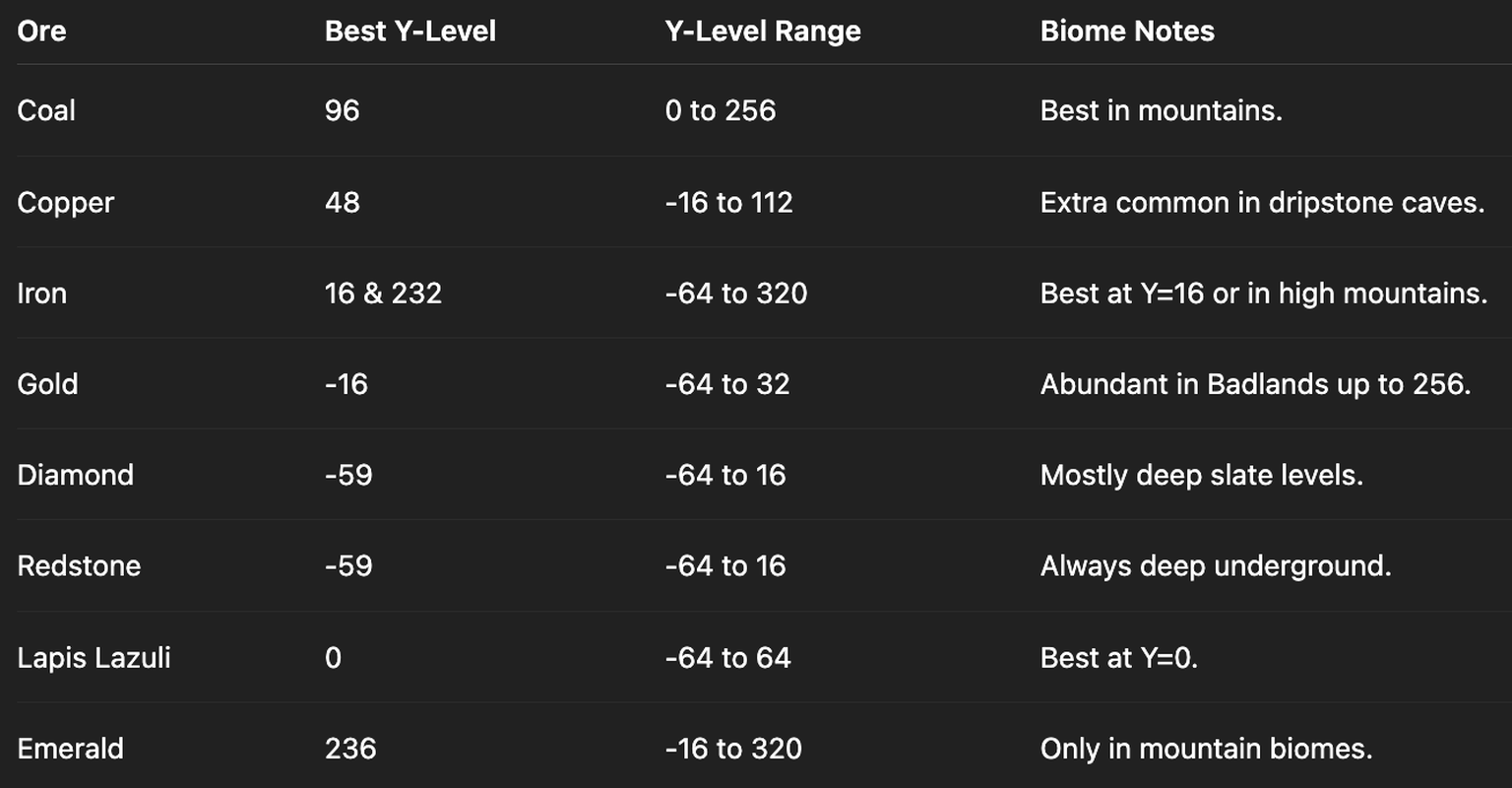
The world now spans from Y=320 (the build limit) down to Y=-64 (bedrock). Ores generate in triangular distributions, meaning each ore has an optimal Y-level where it’s most common, and becomes increasingly rare the farther you move away from that level.
Quick Reference: Best Y-Levels
Deepslate vs. Stone
Once you mine below Y=0, regular stone transitions into deepslate, which takes significantly longer to break. Before committing to deep strip mining, make sure you’re equipped with at least an Iron Pickaxe—though a Diamond Pickaxe with Efficiency is strongly recommended to save time and durability.
Finding Netherite (Ancient Debris)
Netherite upgrades are essential for late-game progression, but Ancient Debris does not spawn in the Overworld, you’ll need to head to the Nether to find it.
- Best Y-Level: Y = 15
- Most Efficient Methods: Bed mining or TNT mining, both of which quickly clear Netherrack and expose Ancient Debris more effectively than traditional mining.
Optimizing Your Server for Mining
Mining and exploration generate new chunks, which can place heavy strain on lower-end servers, especially when players are flying with Elytras or speed-mining with beacons.
At CloudNord, our high-clock-speed Ryzen processors keep chunk loading smooth, even during heavy mining. Ready to start a new Minecraft world? Get 20% OFF on all game servers and mine without lag holding you back.
WildNature,
CloudNord Support Team